
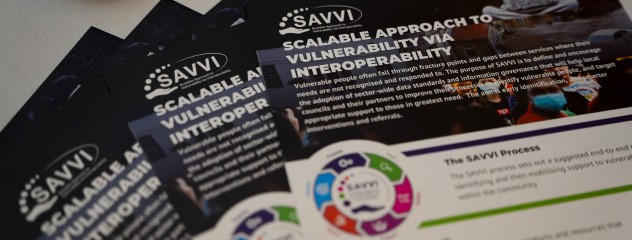
The SAVVI (Scalable Approach to Vulnerability Via Interoperability) team is thrilled to celebrate a significant milestone for public sector data sharing and early intervention. The UK Government’s Digital Service (GDS) and Data Standards Authority (DSA), alongside the Ministry of Housing, Communities and Local Government (MHCLG), have officially published the Vulnerabilities Data Standards as an Alpha for comment and early adopters on GOV.UK
This release represents the formalisation and support of the data models and taxonomies developed through the SAVVI programme towards becoming official central government data standards guidance.
Why this Matters for Public Sector Data Standards
For years, local authorities, NHS trusts, housing associations and emergency services have faced a common obstacle: data fragmentation. Frontline teams hold critical insights about individuals or households at risk, but without standardised data structures, connecting these signals across organisational boundaries requires tailored, resource-intensive integration projects.
This publication establishes a national baseline for capturing, structuring and exchanging vulnerability and risk data legally, ethically and efficiently.
Developed by iStandUK under the SAVVI initiative with support from MHCLG’s Local Digital programme and refined in partnership with the cross-government Vulnerabilities Working Group, this centers on two foundational deliverables. Together, they establish a standardised foundation to accelerate interoperability, reduce integration overhead and uphold strict data minimisation across public services.
The first core deliverable comprises the conceptual and logical data models. These models define standardised entity frameworks for capturing consistent data across individuals, households and multi-agency encounters. By providing pre-defined schemas, the specification streamlines cross-boundary data exchange and lowers integration friction for software vendors. Embedded directly within the architecture is information governance by design: the structures align strictly with UK GDPR and data protection principles, ensuring multi-agency workflows process only the minimum data necessary to fulfill legitimate public tasks.
The second core deliverable is a standardised taxonomy of risk factors. Built around controlled vocabularies and structured hierarchies, the taxonomy spans key public sector domains including health, housing, financial distress and social care. It enforces proportionate data minimisation at the attribute level allowing systems to record necessary risk indicators (such as age brackets) without disclosing raw personal identifiers like full dates of birth. To support automated pipeline integration and modern enterprise architectures, the taxonomy includes spreadsheet specifications and Resource Description Framework (RDF) models for knowledge graph applications.
Testing in Practice: The Greater Manchester Pilot
A data standard is only as good as its real-world implementation. To ensure these models meet frontline operational needs, MHCLG is currently funding a joint SAVVI and Open Referral UK pilot with the Greater Manchester Combined Authority (GMCA).
This pilot tests how SAVVI’s vulnerability identification models work in tandem with Open Referral UK’s service directory standards. By connecting individual risk indicators directly to local support services across municipal and health boundaries.
What’s Next: How to Provide Feedback
As we progress through the Alpha phase, feedback from local authorities, health partners, data architects and software suppliers is critical.
- Review the Standards: Access the full specification on GOV.UK
- Submit Feedback: The Data Standards Authority is actively gathering input on implementation feasibility, vendor compatibility and technical governance
- Deadline: Please submit your technical feedback by 21 August 2026 to data-standards-authority@dsit.gov.uk
If you would like to find out more about the SAVVI project, visit the SAVVI website and get in touch with the team at – info@savviuk.org