

Open Referral UK (ORUK) is moving from focusing on efficiency and data reuse to clarifying the outcomes it exists to enable: fairer access, joined‑up services, and better support for people in every place. ORUK is also already deployed in many places, supporting real services and real users, and that practical reality shapes how we approach its future. This blog shares what the ORUK Visioning Workshop revealed about that shift, and how it will shape stewardship, priorities, and next steps.
When communities talk about service information, the conversation often starts with efficiency: duplication, silos, wasted effort, frontline time. These are real problems, and ORUK, an open data standard that provides a consistent way to publish and describe information, exists precisely because they matter.
At iStandUK, having recently taken on the stewardship of ORUK, we find ourselves in a rare and valuable position: responsible for something that already works, is trusted by many, and has a clear purpose, while also having the opportunity to step back and examine its fundamentals. Rather than rushing into change, we are in a deliberate phase of reflection. We have taken ORUK on largely as‑is, changing very little to maintain continuity and trust, while we work out how best to support its next phase and re‑energise national adoption through iStandUK’s incubation service (from October 2026 onwards). The Open Referral UK Away Day, with the team, steering board members and other external partners in March 2026, was part of creating that space.
Why we changed the starting point
ORUK’s existing benefits clearly describe the data problem it addresses: fragmented service information, duplicated effort, missed opportunities for people to access support, and systems that are difficult to evaluate or improve. Addressing those problems remains valid. We are not moving away from them.
However, as stewards, we wanted to understand something slightly different – not just what ORUK enables, but to understand, ‘what changes in the world when those benefits are consistently realised?’. So instead of asking “what is the future of ORUK?”, our visioning workshop centred on a different question:
What better outcomes are achieved when we share high‑quality, standards‑based service information?
This reframing has helped move the conversation away from solutions and structures, towards impact.
What the visioning workshop produced
During the workshop, participants explored this question individually and collectively. Through facilitated sense‑making, ten outcome clusters emerged, describing what becomes possible when service information is open, trusted, interoperable, and reused across organisations and places. Together, these outcomes describe what becomes possible when service information works as part of a joined‑up system, rather than isolated tools. We have further grouped these 10 clusters into four overarching themes to make it easier to digest.
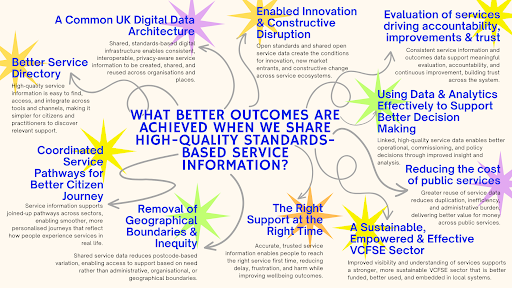
People & Access: the following outcome clusters relate to making it easier for people and practitioners to find, navigate and receive the right support
- The right support at the right time
Accurate, trusted service information enables people to reach the right service first time, reducing delay, frustration, and harm while improving wellbeing outcomes.
- Better Service Directory
High‑quality service information that is easy to find, access, and integrate across tools and channels, making it simpler for citizens and practitioners to discover relevant support.
- Co-ordinated Service Pathways for Better Citizen Journey
Service information supports joined‑up pathways across sectors, enabling smoother, more personalised journeys that reflect how people experience services in real life.
Places & Equity: these clusters relate to reducing variation and ensuring access is based on need, not geographic or organisational boundaries
- Removal of Geographical Boundaries and Inequity
Shared service data reduces location‑based variation, enabling access to support based on need rather than administrative, organisational, or geographical boundaries.
- A sustainable, empowered & Effective VCFSE Sector
Improved visibility and understanding of services supports a stronger, more sustainable Voluntary, Community, Faith, and Social Enterprise sector that is better funded, better used, and embedded in local systems.
Systems & Infrastructure: the following outcome clusters relate to creating the shared foundations that enable joined‑up services at scale
- A Common UK Digital Data Architecture
Shared, standards‑based digital infrastructure enables consistent, interoperable, privacy‑aware service information to be created, shared, and reused across organisations and places.
- Using data and analytics effectively to support better decision making
Linked, high‑quality service data enables better operational, funding, and policy decisions through improved insight and analysis.
- Evaluation of services driving accountability, improvements and trust
Consistent service information and outcomes data support meaningful evaluation, accountability, and continuous improvement, building trust across the system.
Innovation & Sustainability: Ensuring long‑term value, resilience, and continuous improvement across service ecosystems
- Reducing the cost of public and publicly funded services
Greater reuse of service data reduces duplication, inefficiency, and administrative burden, delivering better value for money across publicly funded services and making better use of services from outside the public sector.
- Enabled innovation and constructive disruption
Open standards and shared open service data create the conditions for innovation, new market entrants, and constructive change across service ecosystems.
What this adds to our understanding of ORUK’s benefits
The benefits currently set out on the ORUK website are very strong at answering two essential questions: what problem Open Referral UK addresses, and what improves when service data is standardised and shared. They clearly articulate the challenge of fragmented service information and the practical gains that come from reducing duplication, saving frontline time, and improving service discovery.
What the visioning workshop added was not a different answer, but a deeper one. By starting with outcomes rather than solutions, the conversation implicitly explored how those improvements compound, what changes at different layers of the system, and why these benefits matter beyond efficiency alone.
For example, improvements such as saving frontline workers’ time were framed not simply as operational gains, but as part of a wider chain of impact: reduced stress and frustration for practitioners, improved quality of care, and greater capacity for joined‑up working. In this way, the workshop surfaced cause‑and‑effect pathways, rather than just a list of advantages.
The visioning is also helping us reframe ORUK’s value in outcome terms rather than solution terms. The existing benefits are understandably framed around standards adoption, data reuse, and improving directories, referrals, and initiatives such as social prescribing. In contrast, the workshop deliberately avoided naming ORUK itself as the answer. Instead, it focused on what success looks like in the real world when service information works well.
Across the different outcome clusters, a shared vision emerged: making it easier for people to get the right help, creating fairer outcomes in every place. This is a vision about services and places, not just information. More importantly, it is about services that are organised around local people and their needs, rather than around organisational boundaries or service structures. Information matters because it enables this shift, but it is not in itself the end goal.
That reframing is significant because it suggests that ORUK’s value is strongest when it is judged by what changes for people and places. This perspective provides a clearer north star for decision‑making, a stronger narrative for partners, funders, and policymakers, and a practical way to test whether activity is genuinely aligned to impact rather than effort.
The workshop has also expanded the scale of ambition from better data to better systems. While emphasis to date has primarily described improvements at the level of individual organisations, specific use cases, and frontline workflows, the visioning outputs explicitly named system‑level effects. These included reducing geographical inequity, enabling cross‑sector pathways by default, embedding shared digital infrastructure nationally, improving evaluation and accountability across funding ecosystems, and creating conditions for innovation and new market entrants.
This marks a material shift because it indicates that the community increasingly sees Open Referral UK not just as a tool for operational improvement, but as part of publicly funded digital infrastructure, which is something that requires long‑term stewardship, trust, and collective investment. Crucially, the visioning exercise also surfaced values that were previously implicit. The original benefits statement is necessarily practical and transactional. The workshop outcomes made clear underlying principles such as equity over administrative convenience, “right first time” access over multiple hand‑offs, collective stewardship over organisational optimisation, and prevention and wellbeing over crisis response.
Making these values explicit matters: they shape how trade‑offs are made when resources are constrained, strengthen shared purpose across the community, and clarify priorities.
Why this matters for us as stewards
Stewardship of shared digital infrastructure carries a different responsibility than product ownership. For iStandUK, this exercise was about listening before acting. It is helping us understand what is already strong about ORUK, grounding future decisions in collectively agreed outcomes rather than assumptions. As we prepare to bring ORUK properly into our incubation service, this shared understanding gives us a clearer sense of what we are stewarding and what success should ultimately look like.
The Visioning workshop created a shared lens that we can now test with wider communities and challenge with lived experience, to refine for the next step. We plan to share this collective answer more widely, particularly with sectors and groups whose experiences are most directly shaped by service information, and to invite them to test it against their own realities. This will help to:
- Validate whether the articulated outcomes resonate across different contexts
- Identify gaps, tensions, or unintended consequences
- Strengthen and iterate the vision based on lived experience and delivery insight
The next step will be for ORUK to bring its community together again to reflect on a critical question: What is ORUK’s role in enabling and supporting this shared vision?
The vision that we have created, and are refining, describes system‑level outcomes that no single organisation can deliver alone. Our role as ORUK’s steward is therefore not to own the outcomes themselves, but to understand where it can add the greatest value as a standard, a community, and a piece of shared digital infrastructure.
Once the vision is fully agreed, this next phase will focus on clarifying ORUK’s purpose and priorities in relation to the shared vision, to ensure ORUK’s evolution under iStandUK stewardship remains grounded in shared need and collective benefit. It will help us provide guidance and practical help in applying ORUK to achieve that vision.
Join the conversation
The collective picture set out here is not intended to be final or exhaustive. It reflects the perspectives in the room on the day but we know there are many more voices, experiences, and realities that need to shape how Open Referral UK evolves.
We welcome perspectives from anyone working with service information, and particularly feedback that tests these outcomes against lived experience, delivery realities, or local context. This current phase of work is about listening as much as sharing, and ensuring the collective understanding continues to grow. Contact us with your thoughts and comments at hello@openreferraluk.org.
You can also sign up to the Open Referral UK mailing list to keep up to date with news, future engagement opportunities, and the next steps as ORUK moves into its incubation phase under iStandUK stewardship.
Together, we want to ensure that the future of Open Referral UK is shaped not just by standards and systems, but by the people and communities they exist to serve.